What does it mean to Discover something? I recently discovered a new pop punk playlist on Spotify, though I do not claim to have curated it.
On a more serious note, when people give hot takes on Christopher Columbus on Columbus Day, there are good faith critiques of the holiday (viz. He advocated for enslaving/killing Indigenous people, so why should we honor him?"), and ill-informed hot takes (viz. "He didn't do anything important and didn't discover anything."). The former critique makes a valid case against Columbus Day based on his abuse of Native peoples/the need for Indigenous Peoples' Day (which I fully agree needs to be a day, if not week or month). The latter critique, however, is patently rooted in presentism and misunderstanding. It is reasonable and even noble to critique Columbus for his grievous human rights abuses (take a look at his own journal for his pride in them), but it's simply bad history to say "He didn't even matter, so what's the point of talking about him?"
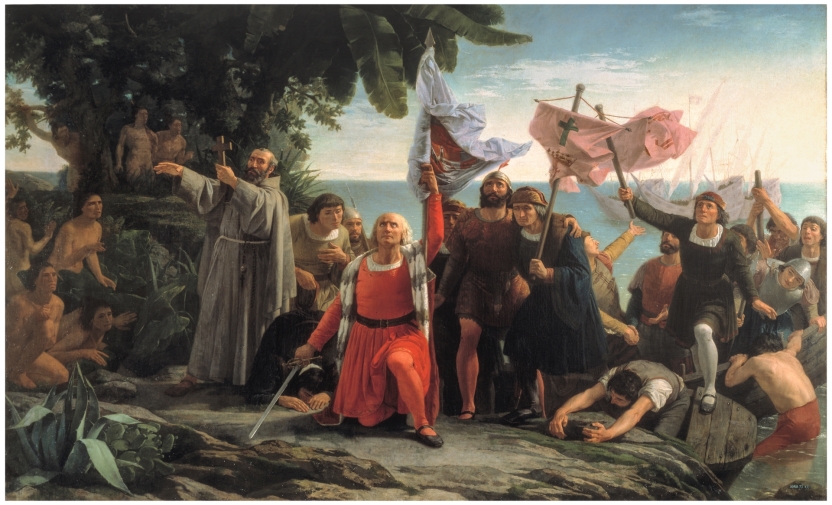
Columbus did "discover" America, but not in the way that modern English allows us to understand. There is no word in the English language that I know of that translates to "I just stumbled upon something important that was previously unknown to me/my group and I forever changed the course of world history." We often define "discover" in 2024 to mean the foregoing, but also to mean "the first to do something." The latter definition is often where modern critics of Columbus Day draw their fire. However, 16th-century Europeans did not operate under the illusion that they were the first inhabitants of North America (which, as you probably know, Columbus mistakenly thought was East Asia).
Take for instance this nearly contemporary work, Silua de Varia Lecion... (1540). Author Pedro Mexia describes Columbus's voyage in the following way: "...Christoual Colon Visorey y almirante mayor delas Indias ocidentales/y el primero que aqlla nauegacion descubrio/y dio nuevo mundo al antiguo mundo." In English: "Christopher Columbus, Viceroy and Prime Admiral of the West Indies/and the first whose navigation discovered/and gave the new world to the old world." (N.B. I was surprised that my intermediate modern Spanish knowledge helped me to understand this!).
In other words, we have a 16th-century Spanish text confirming a basic fact: Columbus connected the Old World to the New, and it was through his maritime voyage.
This particularly meaning of 'Discover' is borne out in English books of the period as well. In the English translation of Jan Huygen van Linschoten's Discours of Voyages Into Ye Easte [and] West Indies ( a 1598 book written just a century after Columbus's fateful landing in the Bahamas and encounter with the Arawak peoples), the author wrote that one of the Caribbean Islands was "Discouered [sic] by Chrostopherus Columbus, in his second voyage into India: There is a verie strange and notable Historie written of the inhabitants hereof, that at the first arriual [sic] of the Spaniards in that Island..."
In other words, the notion that Europeans arrogantly assumed they were the first to sight/land on/inhabit the New World is not borne out by period documents, or in basic common sense. Columbus himself admitted that he wasn't likely to have been the first European navigator in the Western Hemisphere, much less the 'discoverer' of the New World in our modern sense.
III. Takeaways:
I'm not making a moral defense of Columbus (nor do I have any strong feelings about the 'Columbus Day' vs "Indigenous People's Day' Debate, other than to state that the latter is long overdue). Columbus was despicable, and even as a historian, I feel compelled to state that he committed grievous injustices against people who merely attempted to welcome him/trade with him, and his actions led to many genocidal and racist campaigns that followed/decimated Indigenous populations for centuries. I do fear, however, that by only focusing on that legacy when we study Columbus that we forget Native American agency/resistance/culture that survived despite the odds. It's also easy to repeat the worst excesses of the Black Legend when examining the story of Exploration/Exploitation in the New World.
In fact, if anything, I am trying to remind people that "black and white" and presentist simplifications of history are problematic. Simply pretending that morally problematic people were unimportant/not worthy of study blinds us to the full depth and breadth of history.
What Columbus accomplished was both horrific, yet also important/world-changing. How one remembers it (or even "commemorates it") should always begin with an acknowledgement of the importance of Columbus's voyage (pretending that he was a non-actor in history does no justice to the gravity of the story), but also of the humanity and suffering of millions because of his actions. I don't think Columbus Day should be a celebration, but completely doing away with a day where we investigate his legacy may be just as problematic.
History is nuanced and grey. It's messy. But it's important to tell the whole story. I hope everyone has an educational Columbus Day/Indigenous Peoples' Day, and that we use this time to remember to treat our neighbors with the Christian charity and understanding that Columbus so clearly lacked.


Comments
Post a Comment